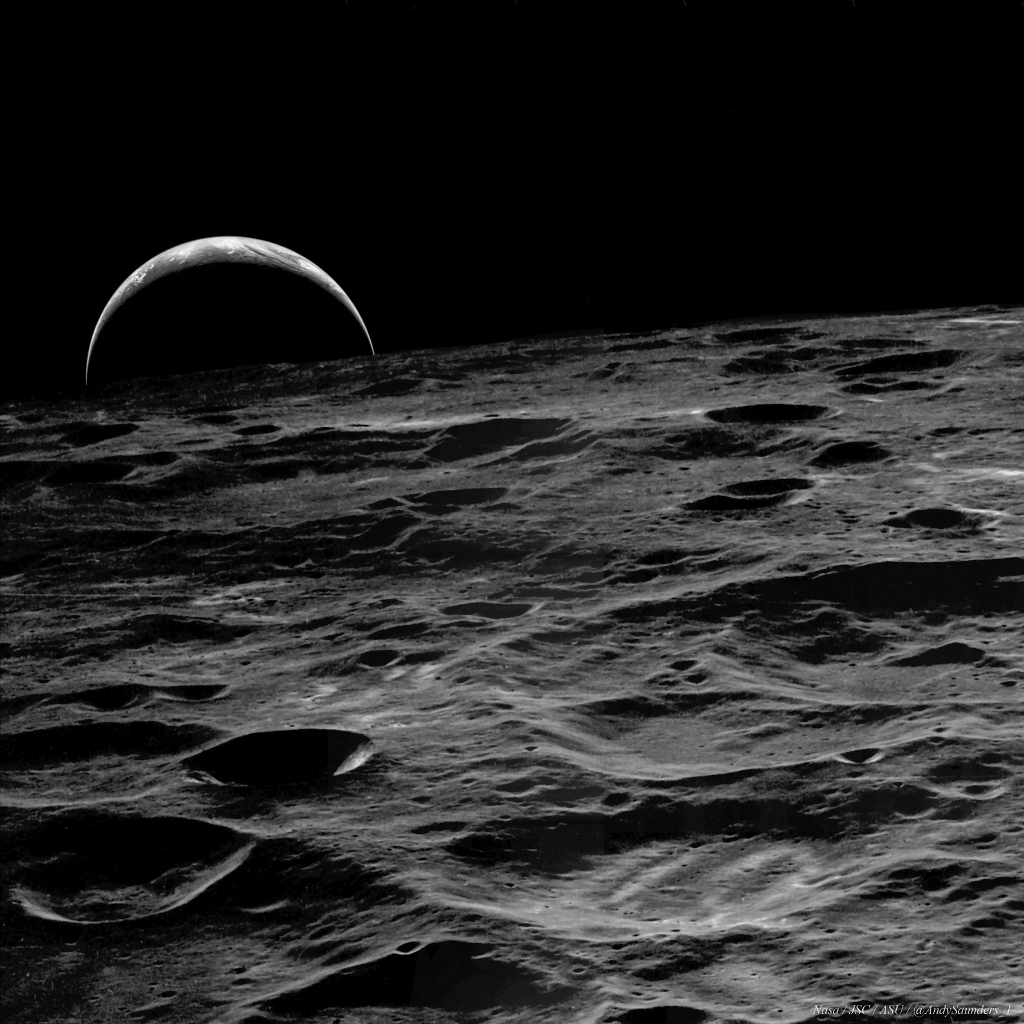
Apollo 14 Heads for Home


When leaving lunar orbit in February 1971, the crew of Apollo 14 watched this Earthrise from their command module Kittyhawk. With Earth's sunlit crescent just peaking over the lunar horizon, the cratered terrain in the foreground is along the lunar farside. Of course, while orbiting the Moon, the crew could watch Earth rise and set, but the Earth hung stationary in the sky over Fra Mauro Base, their landing site on the lunar surface. Rock samples brought back by the Apollo 14 mission included a 20 pound rock nicknamed Big Bertha, later determined to contain a likely fragment of a meteorite from planet Earth. via NASA https://ift.tt/2S7blzx
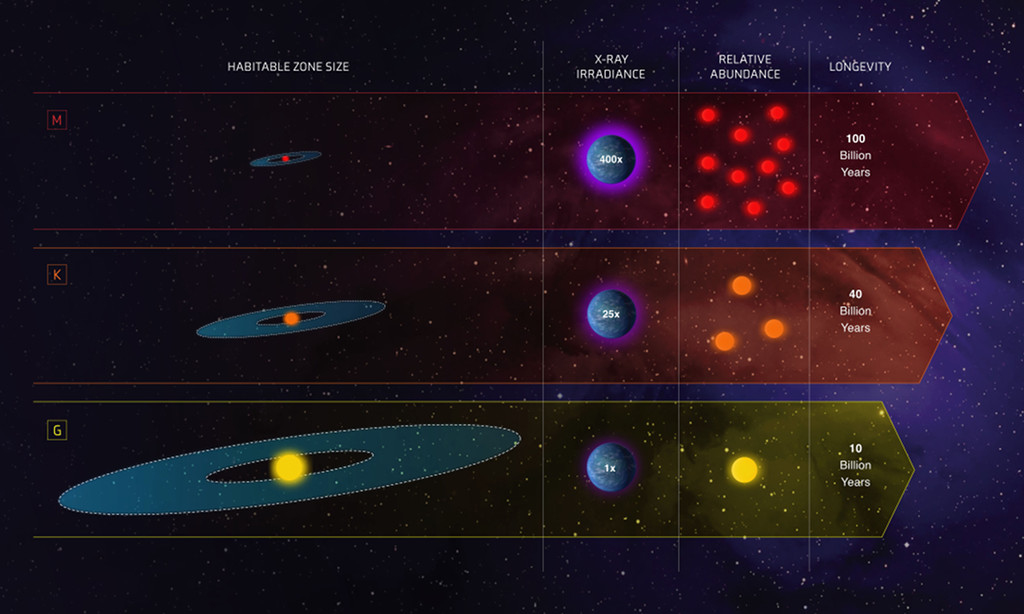
Goldilocks Zones and Stars


The Goldilocks zone is the habitable zone around a star where it's not too hot and not too cold for liquid water to exist on the surface of orbiting planets. This intriguing infographic includes relative sizes of those zones for yellow G stars like the Sun, along with orange K dwarf stars and red M dwarf stars, both cooler and fainter than the Sun. M stars (top) have small, close-in Goldilocks zones. They are also seen to live long (100 billion years or so) and are very abundant, making up about 73 percent of the stars in the Milky Way. Still, they have very active magnetic fields and may produce too much radiation harmful to life, with an estimated X-ray irradiance 400 times the quiet Sun. Sun-like G stars (bottom) have large Goldilocks zones and are relatively calm, with low amounts of harmful radiation. But they only account for 6 percent of Milky Way stars and are much shorter lived. In the search for habitable planets, K dwarf stars could be just right, though. Not too rare they have 40 billion year lifetimes, much longer than the Sun. With a relatively wide habitable zone they produce only modest amounts of harmful radiation. These Goldilocks stars account for about 13 percent of the stars of the Milky Way. via NASA https://ift.tt/36HM1oX

NASA Day of Remembrance


Amy Resnik touches the Space Shuttle Challenger Memorial after a wreath laying ceremony as part of NASA’s Day of Remembrance, Thursday, Jan. 30, 2020, at Arlington National Cemetery. via NASA https://ift.tt/2Ocv1Rg

Luca Parmitano Works to Repair the Alpha Magnetic Spectrometer


Astronaut and station commander Luca Parmitano is tethered to the International Space Station while finalizing thermal repairs on the AMS. via NASA https://ift.tt/37HsQwP