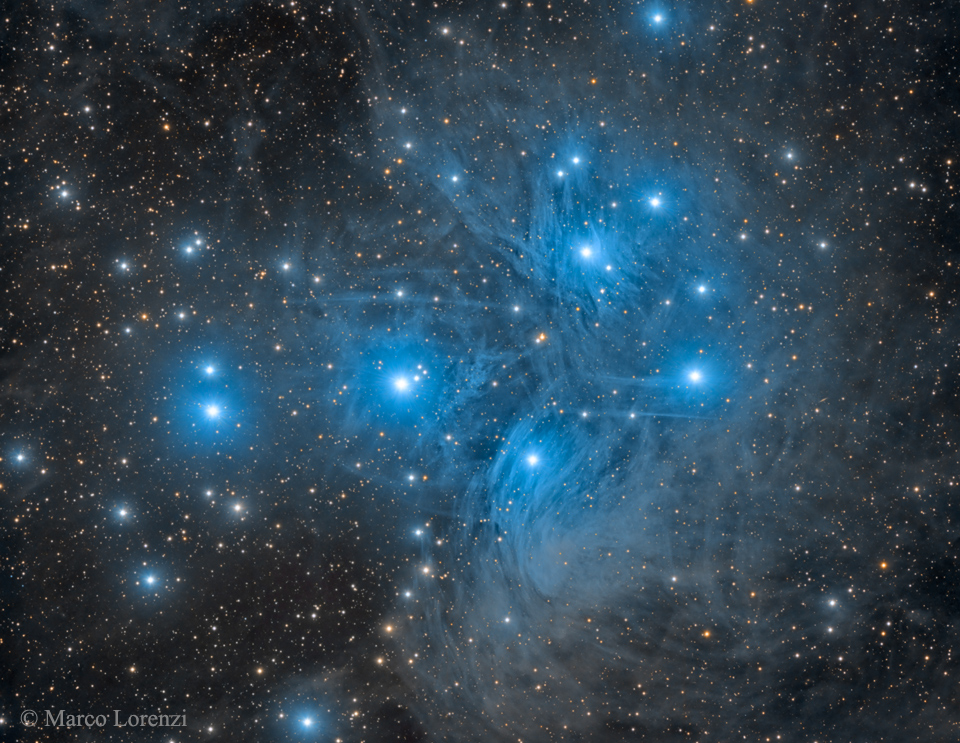
M45: The Pleiades Star Cluster


Have you ever seen the Pleiades star cluster? Even if you have, you probably have never seen it as dusty as this. Perhaps the most famous star cluster on the sky, the bright stars of the Pleiades can be seen without binoculars from even the depths of a light-polluted city. With a long exposure from a dark location, though, the dust cloud surrounding the Pleiades star cluster becomes very evident. The featured exposure took over 12 hours and covers a sky area several times the size of the full moon. Also known as the Seven Sisters and M45, the Pleiades lies about 400 light years away toward the constellation of the Bull (Taurus). A common legend with a modern twist is that one of the brighter stars faded since the cluster was named, leaving only six stars visible to the unaided eye. The actual number of Pleiades stars visible, however, may be more or less than seven, depending on the darkness of the surrounding sky and the clarity of the observer's eyesight. via NASA https://ift.tt/2MOW7ia

Hubble Views Final Stages of a Star’s Life


NGC 5307, a planetary nebula that lies about 10,000 light-years from Earth, can be seen in the constellation Centaurus. via NASA https://ift.tt/2Llc1h6

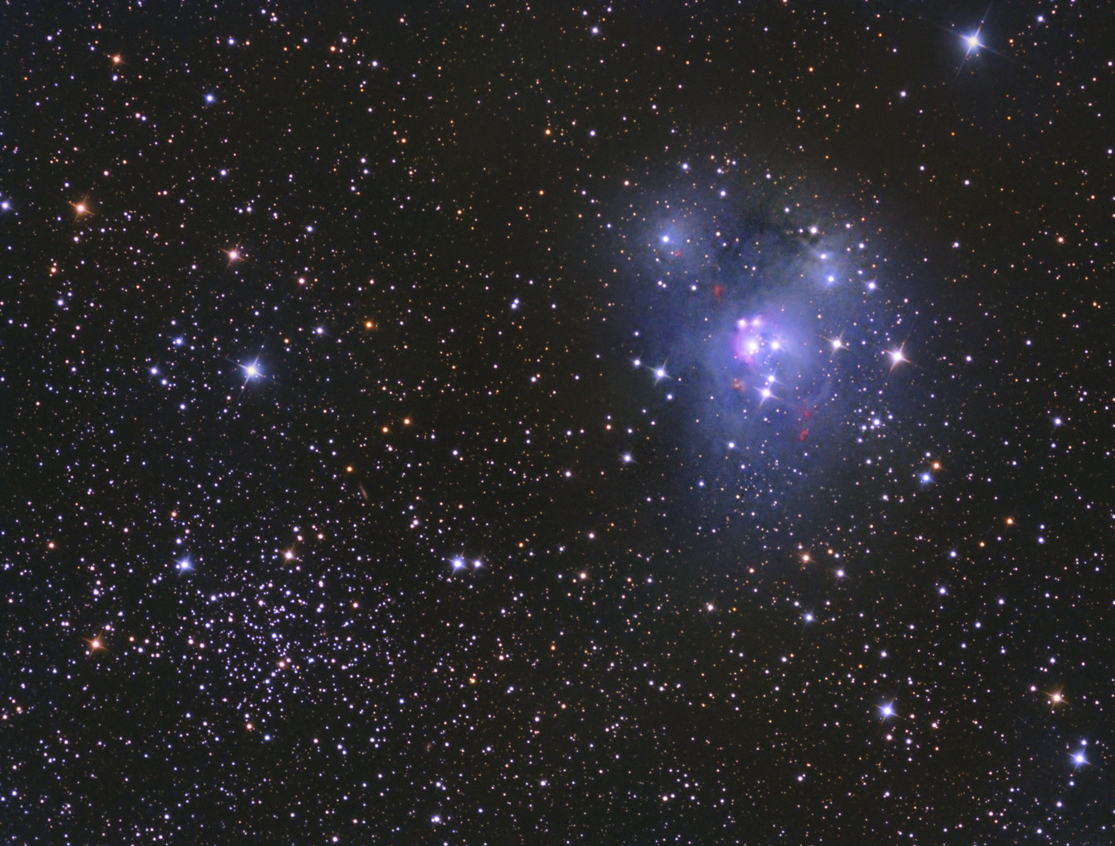
NGC 7129 and NGC 7142


This wide-field telescopic image looks toward the constellation Cepheus and an intriguing visual pairing of dusty reflection nebula NGC 7129 (right) and open star cluster NGC 7142. The two appear separated by only half a degree on the sky, but they actually lie at quite different distances. In the foreground, dusty nebula NGC 7129 is about 3,000 light-years distant, while open cluster NGC 7142 is likely over 6,000 light-years away. In fact, pervasive and clumpy foreground dust clouds in this region redden the light from NGC 7142, complicating astronomical explorations of the cluster. Still, NGC 7142 is thought to be an older open star cluster, while the bright stars embedded in NGC 7129 are perhaps a few million years young. The telltale reddish crescent shapes around NGC 7129 are associated with energetic jets streaming away from newborn stars. via NASA https://ift.tt/2Lg4xfx

Celebrating Spitzer's Sweet Sixteen


Spitzer Space Telescope into orbit around the Sun on Aug. 25, 2003. Since then, the observatory has been lifting the veil on the wonders of the cosmos, from our own solar system to faraway galaxies, using infrared light. via NASA https://ift.tt/2NF8CMW