Canadian Space Agency astronaut Jeremy Hansen is suspended over a mock-up of the International Space Station during a microgravity simulation. via NASA http://ift.tt/2xGWGjb
Dark Matter in a Simulated Universe

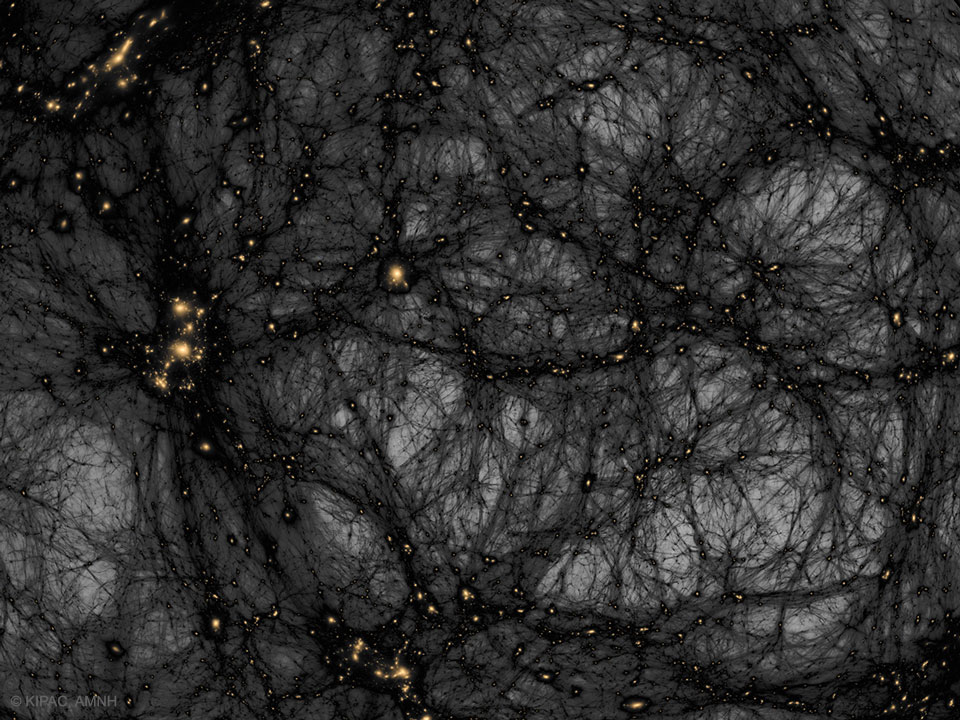
Is our universe haunted? It might look that way on this dark matter map. The gravity of unseen dark matter is the leading explanation for why galaxies rotate so fast, why galaxies orbit clusters so fast, why gravitational lenses so strongly deflect light, and why visible matter is distributed as it is both in the local universe and on the cosmic microwave background. The featured image from the American Museum of Natural History’s Hayden Planetarium Space Show Dark Universe highlights one example of how pervasive dark matter might haunt our universe. In this frame from a detailed computer simulation, complex filaments of dark matter, shown in black, are strewn about the universe like spider webs, while the relatively rare clumps of familiar baryonic matter are colored orange. These simulations are good statistical matches to astronomical observations. In what is perhaps a scarier turn of events, dark matter -- although quite strange and in an unknown form -- is no longer thought to be the strangest source of gravity in the universe. That honor now falls to dark energy, a more uniform source of repulsive gravity that seems to now dominate the expansion of the entire universe. via NASA http://ift.tt/2A0FhDC
Viewing Australia's Great Sandy Desert From Space
Flying hundreds miles above, astronauts aboard the International Space Station photographed Lake Hazlett and Lake Willis in Western Australia's Great Sandy Desert. Hundreds of ephemeral salt lakes are peppered throughout the arid Australian Outback. via NASA http://ift.tt/2luBT0C
Orionid Meteors from Orion

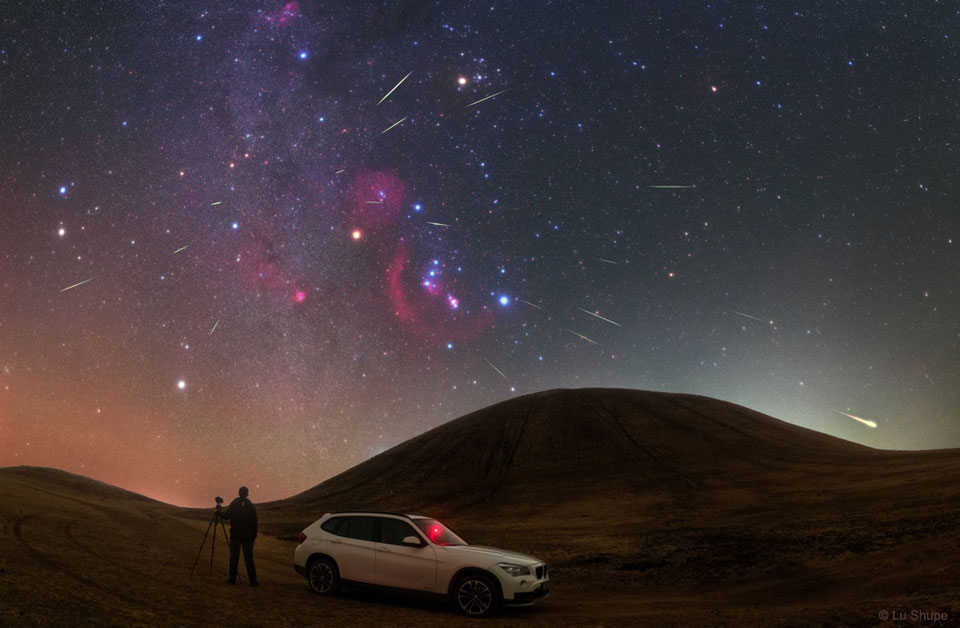
Meteors have been shooting out from the constellation of Orion. This was expected, as October is the time of year for the Orionids Meteor Shower. Pictured here, over a dozen meteors were caught in successively added exposures last weekend over Wulan Hada volcano in Inner Mongolia, China. The featured image shows multiple meteor streaks that can all be connected to a single small region on the sky called the radiant, here visible just above and to the left of the belt of Orion, The Orionids meteors started as sand sized bits expelled from Comet Halley during one of its trips to the inner Solar System. Comet Halley is actually responsible for two known meteor showers, the other known as the Eta Aquarids and visible every May. Next month, the Leonids Meteor Shower from Comet Tempel-Tuttle should also result in some bright meteor streaks. via NASA http://ift.tt/2lr5sQj
Subscribe to:
Posts (Atom)