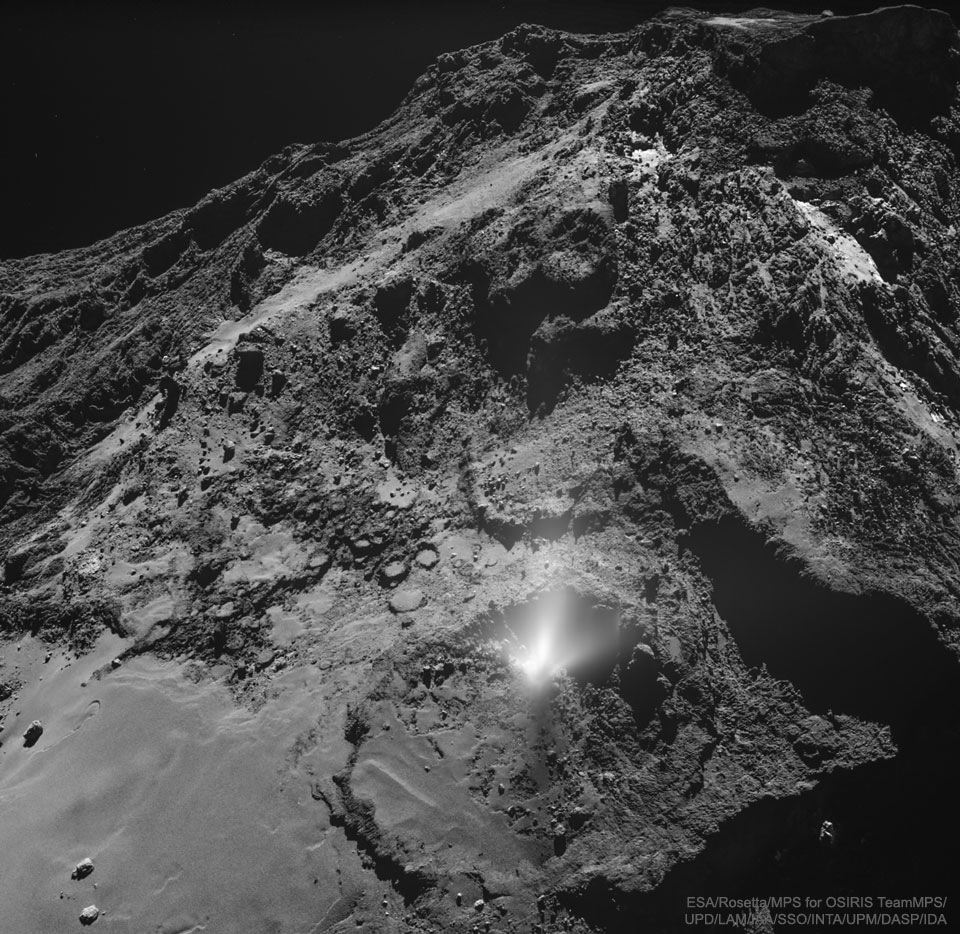
A Dust Jet from the Surface of Comet 67P


Where do comet tails come from? There are no obvious places on the nuclei of comets from which the jets that create comet tails emanate. Last year, though, ESA's Rosetta spacecraft not only imaged a jet emerging from Comet 67P/Churyumov-Gerasimenko, but flew right through it. Featured is a telling picture showing a bright plume emerging from a small circular dip bounded on one side by a 10-meter high wall. Analyses of Rosetta data shows that the jet was composed of both dust and water-ice. The mundane terrain indicates that something likely happened far under the porous surface to create the plume. This image was taken last July, about two months before Rosetta's mission ended with a controlled impact onto Comet 67P's surface. via NASA http://ift.tt/2j1W7O4
Johnny Cueto will remain with Giants after deciding not to opt out of final four years of contract (ESPN)

from ESPN http://ift.tt/1dPqUAn

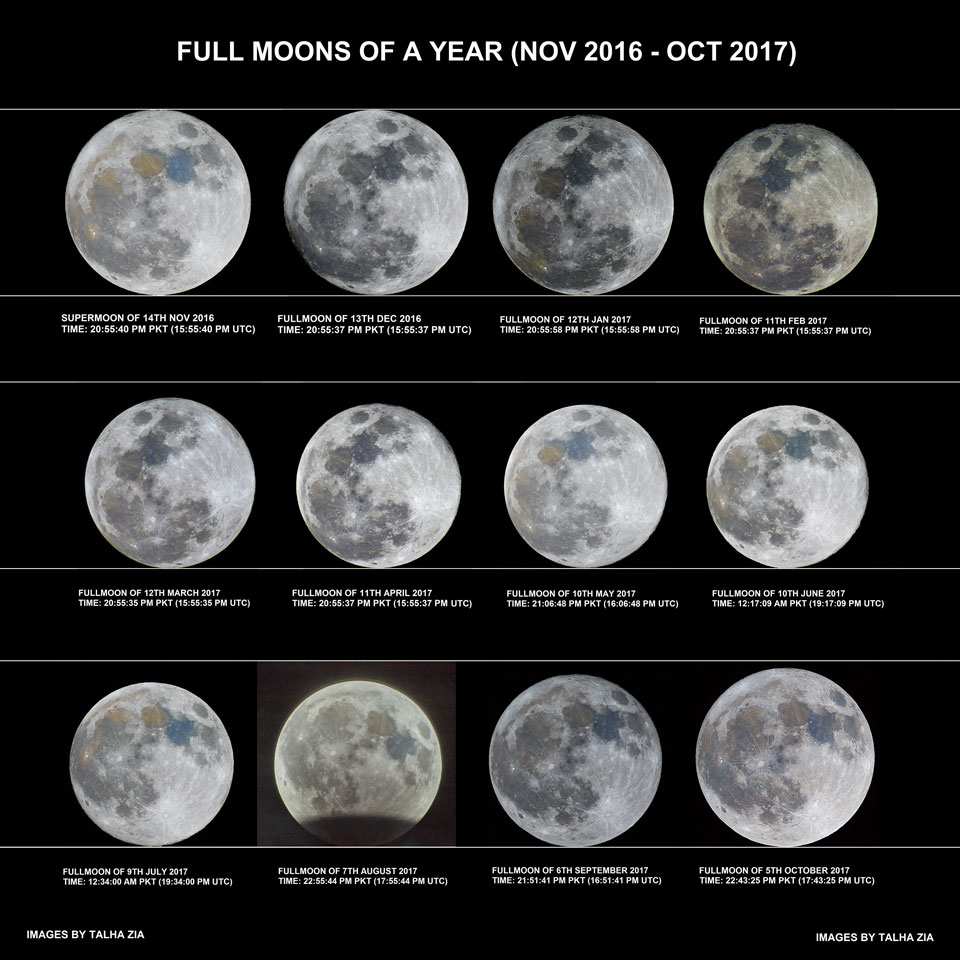
A Year of Full Moons


Do all full moons look the same? No. To see the slight differences, consider this grid of twelve full moons. From upper left to lower right, the images represent every lunation from 2016 November through 2017 October, as imaged from Pakistan. The consecutive full moons are all shown at the same scale, so unlike the famous Moon Illusion, the change in apparent size seen here is real. The change is caused by the variation in lunar distance due to the Moon's significantly non-circular orbit. The dark notch at the bottom of the full moon of 2017 August is the shadow of the Earth -- making this a partial lunar eclipse. Besides the sometimes exaggerated coloring, a subtler change in appearance can also be noticed on close examination, as the Moon seems to wobble slightly from one full moon to the next. This effect, known as libration, is more dramatic and easier to see in this lunation video highlighting all of the ways that the Moon appears to change over a month (moon-th). via NASA http://ift.tt/2lPBaHp

Tests Ensure Astronaut, Ground Crew Safety Before Orion Launches


NASA is performing a series of tests to evaluate how astronauts and ground crew involved in final preparations before Orion missions will quickly get out of the spacecraft, if an emergency were to occur on the pad prior to launch. via NASA http://ift.tt/2zhQOR2